The signal dropped.
The fighter was fast.
He'd read the fight as a fast man's fight, had requested sparring partners who were fast, had worked out the geometry of this fight assuming a close-fighter with unusual speed. And then the fight started and he adjusted: the fighter moved with the quality of someone for whom the movement had stopped being technique and become instinct, so deeply trained that the gap between deciding and doing had collapsed into a single event. He covered the distance in the time it should have taken him to take three steps. He covered it in two.
Arie let him come.
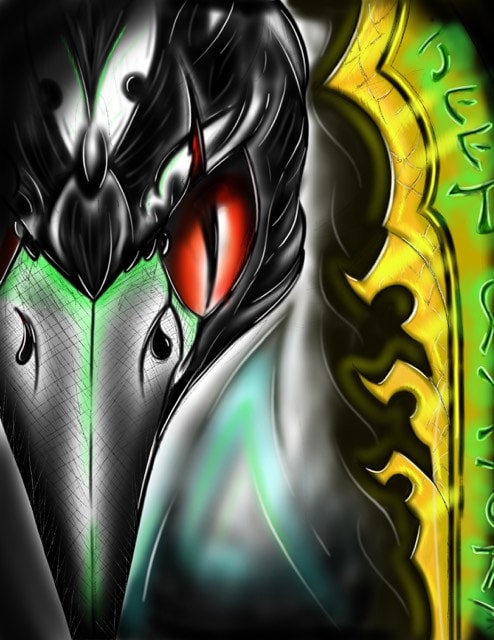
He tracked the angle of the grab attempt. The fighter was going for the wing, which was a correct read, because the wing was leverage and leverage was how you controlled someone this size without matching the size. In the moment before contact, Arie snapped the right wing.
Not a full extension. A sharp lateral motion, a sudden crossing of feathers across the fighter's eye line at exactly the moment the commitment was made. A half-beat of disrupted vision. It wasn't much. He had learned it didn't need to be much.
The fighter's hands caught air.
The spear was already moving. It had read the opening the instant Arie's wing created it. He hadn't signaled, hadn't gestured, hadn't needed to because the spear had been watching both of them and the moment the window appeared it moved through it.
The butt end came across the back of the fighter's knees, clean and horizontal, the kind of hit that took legs out without doing damage that couldn't walk off. The fighter folded correctly, which meant he was a professional who knew how to fall.
Arie was past him before he hit the sand.
The mages had been watching. He could tell from the way they moved when the fighter went down: urgently, suddenly, the kind of fast that came from surprise they hadn't prepared for and were compensating for in real time.
The one on his left had already noticed the positioning problem and was correcting it, already separating, already trying to find a clean lane. She was the more experienced one, he could tell by how quickly the calculation ran. The right mage was younger and his eyes were still processing.
He committed left.
The spell built the way he could feel spells build now, which was something he'd had no name for before the sustenance spell opened the channel and had still not found a precise name for: a sensation something like atmospheric pressure without the atmosphere, a gathering quality, the sense of a thing collecting itself to be released.
She was fast. The gathering had already resolved into direction before he was three-quarters of the way to her.
He cut right.
The spell discharged into the sand where he had been. The sound it made was the sound of something being removed from the world very suddenly, and the temperature shifted — cold, sharp, extractive cold, the specific signature of a spell that worked by pulling heat rather than generating it.
He caught the edge of it across his left shoulder. Not much. A glancing contact. But cold in a way that didn't immediately fade, that settled into the joint and stayed there.
He noted it and kept moving.
The right mage had not finished building. He was still in the recalculation, still wide-eyed, and the proximity of a Ka this tall moving this fast was a gap in what he'd read.
Arie reached him.
He put him down with the precise minimum of force. There was an art to arena takedowns that allowed the person on the floor to tell the story later with some dignity intact, that communicated the capability of more without the use of it, and he had practiced this art because fighting was a profession in this city and professionals had to work with each other again.
The spear had taken care of the left mage.
He turned to find her on the sand and the spear drifting back toward him with the hover it had when it had done something correctly and was waiting for acknowledgment.
He didn't give the acknowledgment. He'd stopped doing that two years ago, around the time he'd realized the dynamic it was creating between them was the wrong one.
The fighter had gotten back up.
He was standing, doing the math. He'd gone down, he'd gotten back up, which was the kind of professionalism worth respecting, and he was running the numbers now: both mages down, opponent intact, solo fight from here.
Arie could watch the numbers come out on the fighter's face.
They came out the same way Arie's numbers had come out six weeks ago.
The fighter sat back down. He held his hands out in the arena gesture for voluntary withdrawal, which was a dignified choice and Arie was glad he'd made it.
The crowd made its noise.
His shoulder was cold where the spell had caught it. He rolled it carefully.
The cold didn't move.